Electromagnetic Fields and Health
Constantly developing technology is rapidly influencing modern life. New technologies are simplifying daily tasks and making time and energy more efficient for people. The press and media occasionally report on the adverse health effects of these increasingly indispensable products. However, the issue remains a topic of research and debate among scientists.
Considering the potential adverse health effects of developing technology, it is essential to take precautions in advance to protect public health. However, even though the consequences are still uncertain, the adverse reports of some press and media institutions have a detrimental impact on people. The World Health Organization defines human health as "a state of complete physical, mental, and social well-being and not merely the absence of disease or infirmity." As seen in this definition, psychological situations are crucial to human health and overall well-being. The Information Technologies and Communication Authority (BTHK) will publish new research, studies, and results on its website, addressing the effects of existing or new, ready-to-use technological devices on human health. This will consciously inform the public, prioritizing public health over unapproved information that negatively affects human psychology.
In the frequency spectrum shown in the table below, there are two types of electromagnetic radiation: ionizing and non-Ionizing, classified according to their energy and according to their effects on living things

- Ionizing EM radiation is in the high-frequency zone that has photon energy that suffices to create ionizing atomic bonds that keep molecules in the cells (i.e., destroying the structure of the atom with an effect on the unloaded neutron that keeps the positive (proton) and negative (electron) loads together in atoms) and it has energy value beginning from a minimum 12eV (electron volt). For example, Roentgen (X-ray) may beam Gamma and Cosmic rays. Being overexposed to these rays is dangerous, as it can cause damage to the organelles in the cells of a living being and to the DNA chain.
- Non-ionizing EM radiation is the Electromagnetic (EM) waves that are composed of photons that do not have the energy to break these atomic bonds. These are visible light, infrared radiation, ultraviolet radiation, radio waves, microwaves, and static and magnetic fields. In brief, it is approximately 1000 GHz at the beginning of 1 Hz (Hertz, a unit of frequency – the number of waves in a second) in the frequency spectrum. The value of the measured energy is, for example, 0.00125 eV at 300 GHz, which is shallow compared to the level required to ionize. However, as these areas cause thermal effects (an increase in body temperature) depending on various factors (distance, strength, time of exposure, etc.), some experts claim they may also cause biological effects. Scientists have not yet proven its cancer-causing effect.
Non-ionizing waves prevent observation of thermal and non-thermal effects on living beings. Electromagnetic energy absorption by the body is converted into heat, raising the body temperature; this describes the thermal effects. The increase in temperature continues until the removal of heat balances it through blood circulation, sweating, and other mechanisms. We still don’t know the non-thermal effects, and we are researching this issue. There are three opinions on the subject.
- The present limit value is high, and Electromagnetic (EM) waves are harmful to human health.
- The effects of EM waves will be apparent in 15-20 years.
- EM waves are harmless as they do not have an ionizing effect.
The scientists are the intended recipients of these three opinions. However, as a country, what we need to do right now is take precautionary measures to mitigate the possibility of such a loss.
Numerous research studies are being conducted on the subject worldwide. ICNIRP (International Commission on Non-Ionizing Radiation Protection) is the leading institution, which is taken as a reference by the World and European countries for determining the limit values for exposure to EM areas. The limited values that this organization determines in the international arena are among the most widely accepted values in many European countries and around the world. ICNIRP is a free research organization that is officially recognized by the World Health Organization (WHO) and the International Labor Organization (ILO). An interdisciplinary team of engineers, biologists, physicists, epidemiologists, and other relevant scientists, in collaboration with universities and research organizations, conducts the studies included in the ICNIRP Guidelines.
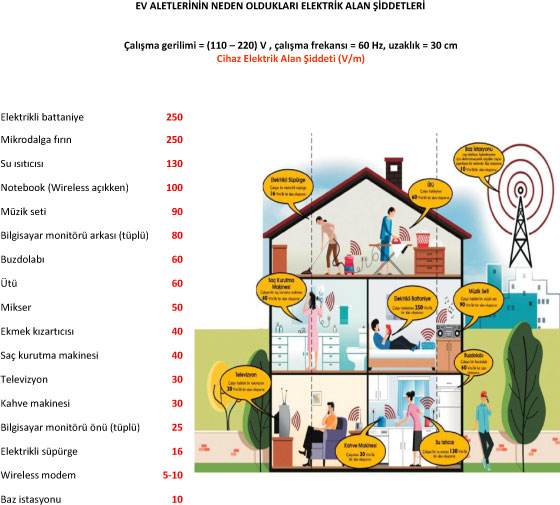
Several factors contributed to the inaccurate public release of information concerning non-ionizing radiation. All devices that operate with electricity emit this radiation at certain levels. ICNIRP, which is supported by the World Health Organization, determines the standards for wireless technology. For reference, the Turkish Republic of Northern Cyprus’s Information Technologies and Communication Authority (BTHK) uses ICNIRP, the world’s most widely recognized and preferred authority amongst EU countries. Scientific studies indicate that exposure to 2,000 volts per meter of non-ionizing radiation can affect human health. The limit value defined by ICNIRP for base stations is 41.2 Volts per meter, and BTHK also accepts it in the TRNC. The Information Technologies and Communication Authority constantly examines current limit values in accordance with the precautionary principle.
Scientific studies conducted worldwide do not provide conclusive evidence of the effects of non-ionizing radiation on human health and the environment. Experts, however, offer guidance on usage patterns.
Even though it is found that both the devices that are being used in electronic communication infrastructures (Radio/TV transmitters, base stations, radio link, etc.) and the devices that are being used by consumers (cell phones, DECT, wireless phones, low power devices, etc.) do not have adverse effects on living beings when used below the limits accepted by the World Health Organization and ICNIRP, the related operators and manufacturers throughout the world should follow the developing technologies closely and be sensitive for taking any measures avoiding no sacrifice to lower the parameters such as EM waves and SAR levels until the continuing researches in this area are completed.
Developing technologies plays a crucial role in making our country reach the information society level. We are confident that science will enable the effective use of new technologies at the highest level in education and across all sectors.